 EN
 INA
Child Language Acquisition in Multilingual and Multicultural Contexts: Indonesian Literature Study Program at Udayana University Holds Guest Lecture with Language Acquisition Expert from Universitas Indonesia
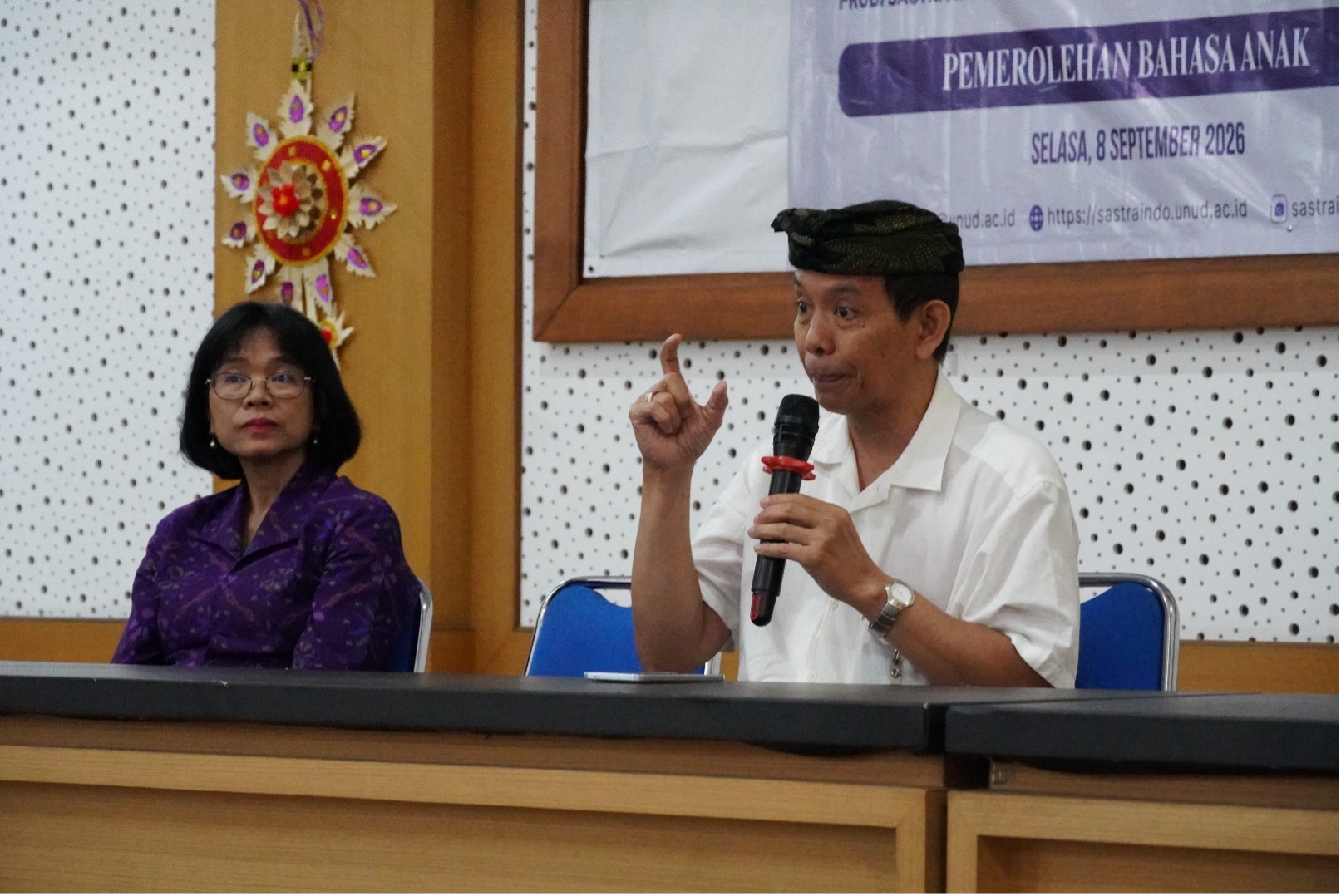
DENPASAR — The Indonesian Literature Study Program, Faculty of Humanities, Udayana University, held a guest lecture entitled “Child Language Acquisition” on Tuesday, September 8, 2026. The academic event featured Dr. Bernadette Kushartanti, M.Hum., a linguistics expert from Universitas Indonesia, as the keynote speaker.
The event was conducted in a hybrid format, taking place offline at the Soekarno Room, Faculty of Humanities, Udayana University, and simultaneously online via Zoom Meeting. This format enabled students and members of the academic community to participate either in person or virtually.
The guest lecture was attended by the Head of the Quality Assurance Unit (UP3M) of the Faculty of Humanities, Udayana University, Dr. Ni Ketut Widiartini Matra Dewi, S.S., M.Hum., several lecturers from the Indonesian Literature Study Program, and students from various cohorts. The event began with an opening session, followed by remarks from the Coordinator of the Indonesian Literature Study Program, Dr. I Gusti Ayu Agung Mas Triadnyani, S.S., M.Hum. In her remarks, she emphasized the importance of strengthening students’ understanding of linguistic phenomena, particularly child language acquisition, which cannot be separated from Indonesia’s linguistic and cultural diversity.
The event continued with remarks from the Dean of the Faculty of Humanities, Udayana University, Prof. Dr. I Nyoman Arya Wibawa, S.S., M.Hum., Ph.D., who officially opened the guest lecture. The opening marked the beginning of the academic session, which provided students with insights and scholarly perspectives from Universitas Indonesia.
The main session was moderated by Ni Komang Diah Restu Swari, S.Pd., M.A., a lecturer from the Indonesian Literature Study Program. In her presentation, Dr. Bernadette Kushartanti discussed child language acquisition, particularly focusing on the dynamics of language use in multilingual and multicultural environments.
One of the key issues highlighted during the presentation was children’s ability to use different languages and language varieties according to their social environment and communicative context. In multilingual settings, children are exposed not only to more than one language but also to various dialects and language varieties. They may even develop the ability to shift between dialects depending on their interlocutors and communicative situations.
In this context, language acquisition is not merely concerned with children’s ability to master linguistic structures, but also with their ability to use language appropriately according to context. The capacity to select an appropriate language variety based on the situation, interlocutor, and social environment constitutes an important aspect of children’s communicative competence.
The presentation was followed by an interactive discussion and question-and-answer session. Students had the opportunity to raise questions and discuss various issues related to child language acquisition, particularly those associated with the multilingual and multicultural nature of Indonesian society. The session provided an opportunity for students to connect theoretical concepts with linguistic phenomena encountered in everyday life.
The guest lecture was organized in response to the increasingly complex nature of linguistic phenomena resulting from social change, technological development, population mobility, and intensified interaction among languages and cultures. In this context, an understanding of child language acquisition is essential for examining how children acquire, use, and adapt language within diverse social environments.
In addition to enriching students’ knowledge, the event formed part of the Indonesian Literature Study Program’s efforts to strengthen academic networks and inter-university collaboration, particularly with other higher education institutions at the national level. The participation of a speaker from Universitas Indonesia is expected to facilitate knowledge exchange while broadening the academic perspectives of both students and lecturers in the field of linguistics.
The guest lecture was also aimed at enhancing students’ academic competencies in child language acquisition, child linguistics, and sociolinguistics, while providing lecturers with broader perspectives on current linguistic research and developments. For students, particularly those in their final years of study, the materials presented are expected to inspire relevant research topics and issues and encourage the development of research with academic novelty for their undergraduate theses.
Through this event, the Indonesian Literature Study Program at Udayana University continues to promote learning activities that go beyond classroom instruction by providing opportunities for students to engage directly with scholars and experts from various academic institutions. The guest lecture is expected to strengthen the academic culture, expand scholarly networks, and encourage students to critically engage with the dynamics of language and society.

FACULTY OF HUMANITIES